


Cornerstone Guide · Prince William County, VA
Family Law in Prince William County: The Complete, Plain-English Guide
Everything I wish every Prince William County family knew before they walked into my office. Divorce, custody, support, property, and how it all actually works in our local courts in Manassas, written plainly and without the legal fog.
By Alisa Chunephisal, Esq. · Founding Partner, NOVA Legal Professionals · Family law attorney serving Prince William, Manassas, Manassas Park & Woodbridge
Bottom Line Up Front
If you only read one box, read this one.
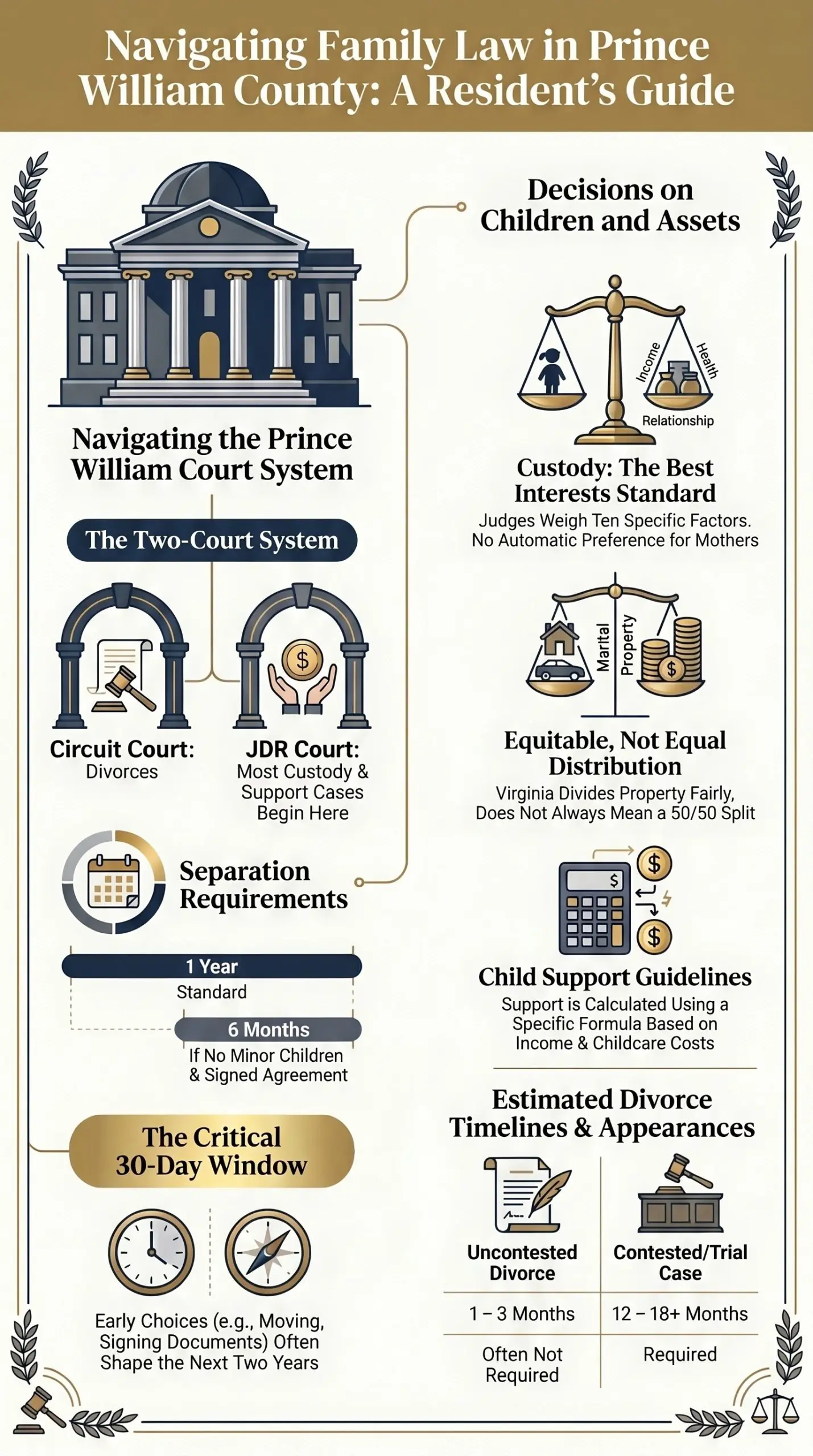
If you are facing a family law matter in Prince William County, here is the short version. Most Virginia divorces are resolved without a trial. A no-fault divorce requires one year of living apart, or six months if you have no minor children and a signed agreement. Custody and support are determined by what is best for the child, based on factors the court must weigh. Property is divided fairly, which does not always mean equally.
Your case will move through the Prince William County Circuit Court or the Juvenile and Domestic Relations Court, both in Manassas, depending on the issue. The choices you make in the first thirty days often shape the next two years. The single most useful thing you can do is talk to a family law attorney before you move out, sign anything, or make a major decision. The first call is a conversation, not a commitment.
What This Guide Covers
Chapter 1: How Family Law Actually Works in Prince William County
Let me start with the piece most people find confusing: which court handles your case? In Prince William County, family law is handled by two different courts, and which one you end up in depends on what your case is about.
The Prince William County Circuit Court, at 9311 Lee Avenue in Manassas, hears divorces, the division of property, and the financial pieces that come with ending a marriage. The Juvenile and Domestic Relations District Court, just up the street at 9311 Lee Avenue, as well, hears most custody, visitation, child support, and protective order cases, especially for parents who were never married to each other.
If you are getting divorced and you have children, your case can touch both courts. Part of my job is making sure the pieces move through the right court in the right order, so nothing falls through a crack.
A Local Detail That Matters
Prince William County is one of Virginia’s fastest-growing jurisdictions, and the court dockets reflect that. Schedules fill up, and judges expect attorneys who know local procedure and show up prepared. Our Manassas office is steps from the courthouse complex on Lee Avenue, and we know the people who run those courtrooms by name.
Everything in this guide is grounded in Virginia law, which applies statewide, but I have written it for how things actually play out in Prince William. For the full picture of our Manassas office and the local courts we appear in, see our Prince William County page.
Chapter 2: Divorce in Prince William County, Start to Finish
Virginia recognizes two kinds of divorce, but most people only need the second one. A divorce from bed and board is a limited, partial divorce. An absolute divorce is the full and final kind that ends the marriage completely. When people say “divorce,” they almost always mean this.
You need a reason the law recognizes
Virginia does not let you file simply because the marriage is over. You need a legal ground. The most common is the no-fault ground, which means you have lived separate and apart for the required time.
- One year of separation if you share minor children.
- Six months of separation if you have no minor children and you both signed a property settlement agreement.
Fault grounds also exist, including adultery, cruelty, desertion, and a felony conviction. Fault can matter for support and, in some cases, property. But fault cases are harder, slower, and more expensive, so we only pursue them when the facts truly call for it. (Va. Code § 20-91)
Where and how you file
To file in Virginia, at least one spouse must have lived in the Commonwealth for at least six months before filing. The case begins with a Complaint filed in the Prince William County Circuit Court, and the other spouse is then served with 21 days to respond. (Va. Code § 20-97, § 20-99)
For the full walk-through of types of divorce, the timeline, and what each stage looks like, read our main divorce practice area page.
How Long It Takes
An uncontested Prince William divorce with a signed agreement can finish in roughly one to three months once the separation period is met. A contested case that goes to trial usually takes twelve to eighteen months, sometimes longer. The more you and your spouse can agree on, the faster and cheaper it goes.
Chapter 3: Child Custody and Visitation
Custody is the issue that keeps parents up at night, and I understand why. In Virginia there are two parts to custody: legal custody, the right to make major decisions about a child, and physical custody, where the child actually lives.
The court decides custody based on one standard above all others: the best interests of the child. Virginia law lists ten factors the judge must weigh, including the child’s age and needs, the relationship each parent has with the child, each parent’s ability to support the child’s relationship with the other parent, and any history of family abuse. (Va. Code § 20-124.3)
A few things parents get wrong
- There is no automatic preference for mothers. The court looks at the child, not at gender.
- Children do not simply “choose” at a certain age. A mature child’s preference is one factor, not the deciding one.
- Badmouthing the other parent almost always hurts your case, because willingness to support the child’s relationship with the other parent is a factor the judge weighs directly.
For the deeper explanation of custody arrangements and parenting plans, see our child custody page and our page on child visitation.
“Day one matters. The choices you make in the first thirty days of a separation often shape the next two years of your custody case. Get advice before you move, not after.”
Alisa Chunephisal, Esq. · Founding Partner
Not sure where your case even starts?
That is exactly what a first call is for. Tell us what is going on, and we will tell you which court, which step, and what to expect. No pressure, no judgment.
Chapter 4: Child Support, and How the Number Is Set
Child support in Virginia is not a guess and it is not up to the judge’s mood. It comes from a formula set in state law, called the guidelines. The formula uses both parents’ incomes, the cost of health insurance for the children, work-related childcare costs, and the number of days the child spends with each parent. (Va. Code § 20-108.2)
The guideline number is presumed correct, but a Prince William judge can adjust it up or down for specific reasons permitted by law. Special expenses, like a child’s medical needs or private school, can support a deviation from the standard number. (Va. Code § 20-108.1)
Things that change the number
- Shared custody. When a child spends more than ninety days a year with the paying parent, a different calculation applies.
- Income changes. Support can be modified later if either parent has a material change in circumstances.
- Other children. Support obligations for other children can factor in.
For the full breakdown, including how support continues for some adult children with disabilities, read our child support page.
Chapter 5: Spousal Support, Also Called Alimony
Spousal support is one of the least predictable parts of Virginia family law, because unlike child support, there is no single statewide formula for the final amount. Instead, the court weighs a long list of factors, including the length of the marriage, the standard of living during the marriage, each spouse’s income and earning ability, and the contributions each made to the family. (Va. Code § 20-107.1)
There are really two questions. First, is support appropriate at all? Second, if so, how much and for how long? Support can be temporary while the case is pending, for a set number of years, or in longer marriages, indefinite.
A Word About Fault
In Virginia, fault can affect spousal support. For example, proven adultery can bar a spouse from receiving support in many cases, though there are exceptions. This is one area where the facts of how a marriage ended can change the financial outcome.
For more on how support is calculated and modified, see our spousal support page.
Chapter 6: Dividing Property and Debt, Fair Not Always Equal
Virginia is what we call an equitable distribution state. That word, equitable, is the one to remember. It means the court divides marital property fairly, which is not the same as splitting everything fifty-fifty. (Va. Code § 20-107.3)
The first step is sorting what counts. Marital property is generally anything you acquired during the marriage, regardless of whose name is on it. Separate property is what you owned before the marriage, or received as a gift or inheritance to you alone. The tricky part is when the two get mixed together, which the law calls commingling.
What gets divided
- The marital home, often the largest and most emotional asset.
- Retirement accounts, pensions, and the federal Thrift Savings Plan.
- Bank accounts, investments, and businesses built during the marriage.
- Debts, including mortgages, loans, and credit cards taken on during the marriage.
Retirement and pension division has its own rules and often needs a special court order to divide correctly. Getting that order right the first time matters, because mistakes here are expensive to fix later.
Chapter 7: Protective Orders and Family Safety
Some family law cases are not about money or schedules. They are about safety. If you or your children are in danger, Virginia law provides protective orders, and Prince William County takes them seriously.
There are three levels. An emergency protective order can be issued quickly, often through law enforcement, and lasts a short time. A preliminary protective order bridges the gap until a full hearing. A permanent protective order can last up to two years and can be extended. (Va. Code § 16.1-253.1, § 16.1-279.1)
If You Are in Immediate Danger
Call 911 first. A protective order is a legal tool, not an emergency response. If you are being threatened or harmed right now, contact law enforcement immediately. The Virginia Family Violence and Sexual Assault Hotline is 1-800-838-8238, and the National Domestic Violence Hotline is 1-800-799-7233. ACTS in Prince William County also operates a local 24-hour helpline for domestic violence survivors at 703-221-4951.
Protective orders can also be misused, and being served with one has serious consequences for your gun rights, your housing, and your custody case. Whether you need protection or have been served, see our protective orders page.
Chapter 8: Military and Federal Families in Prince William
Prince William County is home to a large share of Northern Virginia’s military and federal families. Marine Corps Base Quantico sits in the southern part of the county, and many residents work at the Pentagon, Fort Belvoir, or one of the dozens of federal agencies in the region. Their divorces come with rules that ordinary cases do not.
- Military pensions are divided under a federal law called the Uniformed Services Former Spouses’ Protection Act, which has its own requirements.
- The Servicemembers Civil Relief Act can pause a case while a servicemember is deployed, protecting them from default.
- Residency and filing can be complicated when a servicemember is stationed far from home or moves often. A 2026 update to Virginia law confirms that members of the Armed Forces and federal employees stationed in a territory or foreign country are deemed to have been domiciled in Virginia during the six months before being stationed away, provided they lived in Virginia during that period and returned to Virginia.
- Federal benefits, like the Thrift Savings Plan and survivor benefits, need careful handling.
If you or your spouse serves, or works for the federal government, these details are not side issues. They are central. Our military divorce page goes deeper.
Chapter 9: Staying Out of Court When You Can
Here is something a lot of people do not expect to hear from a litigator: the courtroom is usually the last resort, not the first. Most Prince William cases settle, and settling is often faster, less expensive, and far easier on children. There are several ways to get there.
Uncontested divorce
When both spouses agree on everything and sign a settlement agreement, the divorce can often be finished without a single court appearance. See our uncontested divorce page.
Mediation
A neutral mediator helps the two of you reach an agreement, while each side can still get legal advice. It works well when both people are willing to talk. Read more on our mediation page.
Collaborative divorce
Both spouses and their attorneys agree, in writing, to resolve everything without going to court, often with financial and child specialists at the table. Our collaborative divorce page explains how it works.
My Honest Take
I push for the right settlement, and I go to trial only when the alternative is worse for my client. Settling when you can and fighting when you must is not a slogan. It is how good family law is actually practiced.
Chapter 10: Choosing the Right Family Law Attorney in Prince William
You are about to trust someone with your children, your home, and your finances during one of the hardest seasons of your life. That is a big decision, so choose carefully. Here is what I would look for if I were on your side of the desk.
- Family law focus. You want someone who does this work and not a little of everything.
- Local experience. Familiarity with the Prince William courts, clerks, and procedures helps your case move smoothly.
- Straight answers. A good attorney will tell you a hard truth in the first meeting rather than a comfortable story you have to unlearn later.
- A real plan. You should leave the first meeting understanding your options, the likely path, and roughly what it will cost.
At our firm, family law is one hundred percent of what we do, our attorneys carry decades of combined Northern Virginia experience, and our Manassas office is right next to the Prince William courthouse complex. You can read more about our firm and meet the people who would handle your case.
Authoritative References
Sources and further reading
Family law is set by statute and applied by the courts. These are the primary, authoritative sources behind this guide. The law changes, so always confirm the current version with an attorney before you act.
- Code of Virginia, Title 20 (Domestic Relations). The statutes governing divorce, custody, and support, including § 20-91, § 20-107.1, § 20-107.3, § 20-108.1, § 20-108.2, and § 20-124.3. law.lis.virginia.gov/vacode/title20
- Code of Virginia, Title 16.1. Protective order provisions, including § 16.1-253.1 and § 16.1-279.1. law.lis.virginia.gov/vacode/title16.1
- Virginia’s Judicial System. Court information, forms, and the child support guidelines worksheet. vacourts.gov
- Prince William County Circuit Court. Hears divorce and equitable distribution cases for county residents. pwcva.gov/department/circuit-court
- Prince William County Juvenile and Domestic Relations District Court. Hears most custody, visitation, support, and protective order matters. vacourts.gov/courts/jdr/prince_william
- Virginia State Bar. Attorney licensing, professional conduct, and public resources. vsb.org
Frequently Asked Questions
How long does it take to get divorced in Prince William County?
It depends on whether the divorce is contested. An uncontested divorce, where both spouses agree on the terms and have signed a settlement agreement, can be finalized in roughly one to three months once the required separation period is met. The separation period is one year if you share minor children, or six months if you have no minor children and a signed agreement. A contested divorce that goes to trial usually takes twelve to eighteen months, sometimes longer.
Which Prince William court will handle my case?
It depends on the issue. The Prince William County Circuit Court at 9311 Lee Avenue in Manassas hears divorces, the division of property, and the financial parts of ending a marriage. The Juvenile and Domestic Relations District Court hears most custody, visitation, child support, and protective order cases, especially for parents who were never married. A divorce involving children can touch both courts.
How is child custody decided in Virginia?
Virginia courts decide custody based on the best interests of the child. The law lists ten factors a judge must weigh, including the child’s age and needs, the relationship each parent has with the child, each parent’s ability to care for the child, and any history of family abuse. There is no automatic preference for mothers, and children do not simply choose where to live at a set age. A mature child’s preference is one factor among many.
How is child support calculated in Prince William County?
Child support in Virginia comes from a formula set in state law called the guidelines. The formula uses both parents’ incomes, the cost of the children’s health insurance, work-related childcare costs, and the number of days the child spends with each parent. The guideline number is presumed correct, but a judge can adjust it for specific reasons the law allows, such as a child’s special medical or educational needs.
Is Virginia a 50/50 property state?
No. Virginia is an equitable distribution state, which means the court divides marital property fairly, not necessarily equally. The court first sorts what is marital property, generally acquired during the marriage, from separate property, generally owned before the marriage or received as a gift or inheritance to one spouse. Fair can mean a 50/50 split, but it often does not, depending on the facts of the marriage.
Do I have to go to court to get divorced?
Often, no. If you and your spouse agree on every issue and sign a property settlement agreement, your divorce can usually be finalized in Virginia by submitting paperwork without a contested hearing. Mediation and collaborative divorce are two structured ways to reach that agreement. A trial is generally needed only when there are issues the spouses cannot resolve on their own.
When You Are Ready
Have a Prince William County family law question? Let’s talk it through.
I wrote this guide so you would walk in informed. The next step is a real conversation about your situation, not a generic one. The first call is a conversation, not a commitment.