


Fort Belvoir, Virginia · Military Divorce
If you are stationed at or near Fort Belvoir and facing a divorce, the question that keeps you up at night is often the same one: what happens to the retirement you have spent a career earning. The short answer is that military retired pay is treated as marital property in Virginia and can be divided, but federal law sets the rules, and a few of them decide whether your share is protected or quietly lost. Take a breath, because this is workable, and let me walk you through it with care.
By Corrie Sirkin, Esq. · Founding Partner, NOVA Legal Professionals
This article is one part of our larger military divorce guide. For the full picture, start with our cornerstone, Military Divorce in Virginia. Here, I will focus on how military retirement is divided, the heart of most Fort Belvoir cases.
First, a word for the service member and the spouse
A divorce in a military family carries weights a civilian divorce does not. You may be reading this between duty hours or on a laptop half a world away on deployment, trying to make sense of something that feels impossible to manage from where you stand. Whether you wear the uniform or have spent years holding a household together through every move and every absence, your worry is understandable, and your service, in every sense, is real. The law has a fair path through this, and you do not have to find it alone.
Retirement is usually the largest asset of all
For a career service member, military retired pay is often worth more than the house, the vehicles, and the savings combined. That is why it sits at the center of so many Fort Belvoir divorces. Virginia treats the marital share of that retirement as property subject to equitable distribution, and the division is governed by a federal law, the Uniformed Services Former Spouses’ Protection Act, often shortened to USFSPA. It lets a state court divide disposable retired pay, but it does not force any particular split. That part is decided here, under Virginia law.
The marital share, explained simply
The piece that can be divided is generally the part of the pension earned during the marriage, not the whole pension. Courts commonly look at the months the couple was married during creditable service compared to the total months of service. The result is the marital share, and the former spouse’s portion is carved from that, not from retirement earned before the marriage or, in most cases, after it. You can read more on our military retirement division page, which walks through the calculation in plain terms.
The Frozen Benefit Rule, for Divorces After 2017
Here is a change that surprises people. For divorces finalized after December 2017, the former spouse’s share is generally frozen at the service member’s rank and years of service at the time of the divorce, based on High-3 pay then, not on later promotions or longevity raises. It still earns cost of living increases, but the value of the rank you make after the divorce is yours. Counting this correctly matters for both sides, and it is easy to get wrong.
Worried about your retirement at Fort Belvoir?
Tell me your service dates and marriage dates, and I will help you see how the marital share actually works out. No pressure, no commitment, just clarity.
The 10/10 rule is widely misunderstood
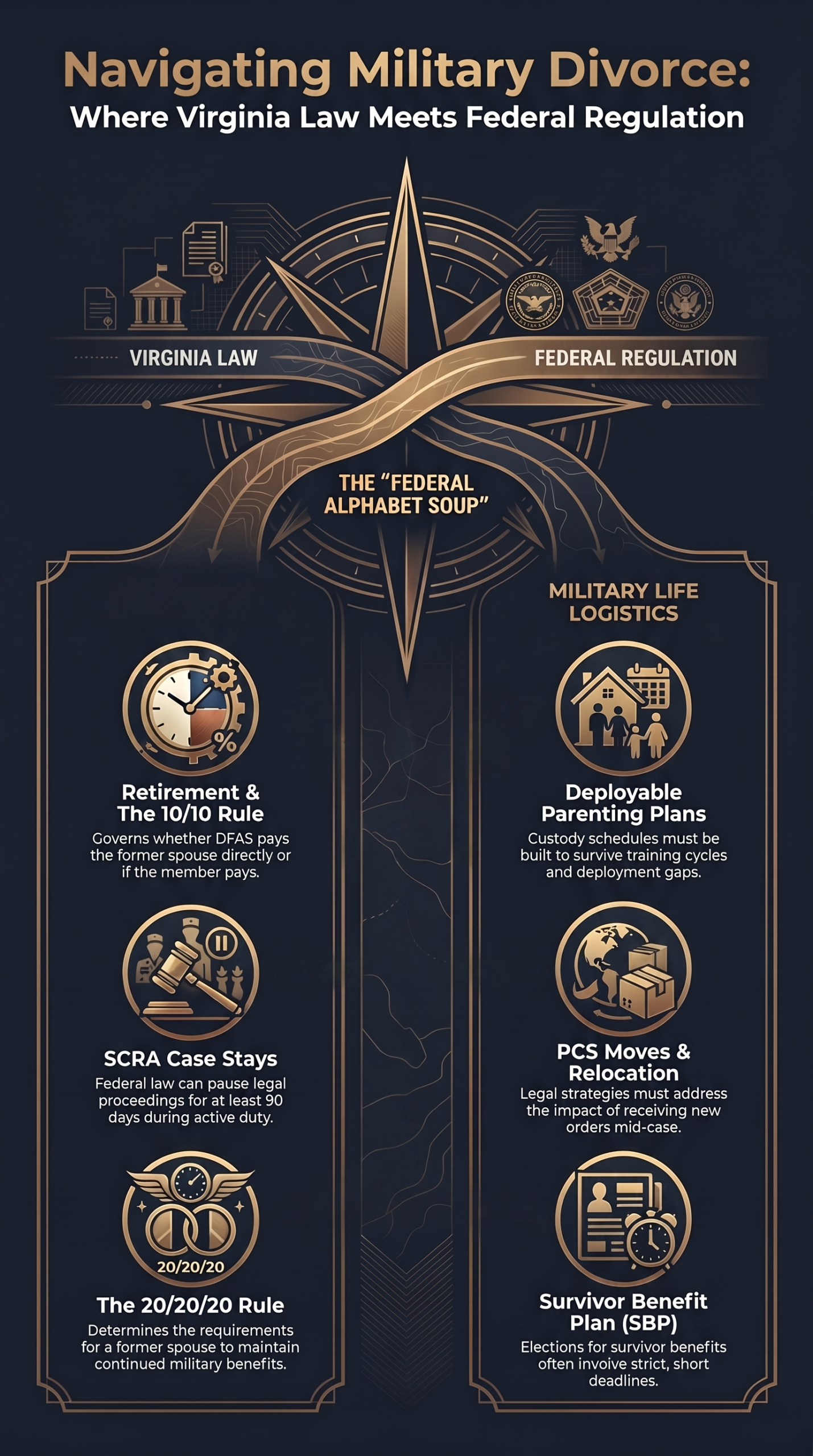
Many people believe that unless the marriage lasted ten years overlapping ten years of service, the spouse gets nothing. That is not true, and the misunderstanding has cost spouses money they were owed. The 10/10 rule decides only one thing: whether the Defense Finance and Accounting Service, the pay center known as DFAS, will pay the former spouse’s share directly. Fall short of 10/10 and the former spouse can still receive a share. It simply comes from the service member each month instead of from DFAS. Entitlement and payment method are two different questions.
When one spouse is deployed or stationed overseas
A great many Fort Belvoir families are navigating this while one spouse is far from Virginia, sometimes overseas with limited connectivity and no easy way to sign documents, attend a hearing, or gather records. That reality does not have to stall everything. Service members have real protections that can pause a case during deployment, and a good deal of the work, the document review, the retirement calculations, the negotiation, can move forward by phone and email while you are away. We are used to representing clients we have never met in person because they were serving when the case began.
Why the order language is not a formality
A retirement division is only as good as the order that carries it out. DFAS reads these orders strictly, and an order that does not use the language the pay center requires can be rejected, sending you back for months of refiling. We draft the military pension order to satisfy both the Fairfax Circuit Court and the pay center, so the share you negotiated is the share that actually arrives. For a career earned across deployments and duty stations, that precision is worth everything.
How we help at Fort Belvoir
We calculate the marital share correctly, account for the Frozen Benefit Rule, clear up the 10/10 confusion, and draft orders DFAS will honor, all while working around the realities of duty and deployment. Fort Belvoir divorces are filed in the Fairfax Circuit Court, and we represent service members and military spouses across the post and the surrounding Fairfax communities. You can read more on our military retirement division page, and you are welcome to reach us whenever the timing works for you, stateside or abroad.
“For a career service member, the retirement is the life’s work. Getting the order right is how we make sure it is protected for the long run.”
Corrie Sirkin, Esq. · Founding Partner
Corrie’s Honest Counsel
Gather your service and marriage dates early, because the marital share depends on them. Do not assume the 10/10 rule decides whether you receive a share, since it only decides who writes the check. And if you are deployed or stationed overseas, reach out anyway, because most of the work can move forward without you in the room, and waiting can cost you options.
Get the share calculated and the order drafted correctly, and a lifetime of service stays protected through the divorce and long after.
Authoritative References
Sources
- Uniformed Services Former Spouses’ Protection Act, 10 U.S.C. § 1408. Authorizes state courts to treat disposable military retired pay as marital property and sets the 10/10 rule for direct payment by DFAS.
- National Defense Authorization Act for FY2017. Established the Frozen Benefit Rule for divorces after December 2017, fixing the former spouse’s share at the member’s rank and service at the time of divorce.
- Code of Virginia, § 20-107.3. Virginia’s equitable distribution statute, under which the marital share of a pension is divided.
- Fort Belvoir and Fairfax Circuit Court. Military divorces for families at Fort Belvoir are filed in the Fairfax Circuit Court.
Federal and Virginia authority verified as of June 2026. Every military divorce turns on its own facts; confirm current rules for your situation.
Frequently Asked Questions
Is military retirement divided in a Virginia divorce?
Yes. Military retired pay is treated as marital property, and the marital share can be divided under Virginia’s equitable distribution law, within the limits of the federal USFSPA.
What is the 10/10 rule?
It decides only whether DFAS pays the former spouse’s share directly. It takes ten years of marriage overlapping ten years of service. Spouses who fall short can still receive a share, paid by the service member instead.
What is the Frozen Benefit Rule?
For divorces after December 2017, the former spouse’s share is generally frozen at the member’s rank and years of service at the time of divorce, based on High-3 pay then, with cost of living increases but not later promotions.
Can we move forward if one of us is deployed overseas?
Often yes. Much of the work can proceed by phone and email, and deployed service members have protections that can pause hearings until they can participate.
When You Are Ready
Let’s protect what you earned at Fort Belvoir.
Tell me your service and marriage dates, and I will help you understand the marital share and the order it takes to protect it. The first call is a warm, no pressure conversation.