


Cornerstone Guide · Northern Virginia
Military Divorce in Northern Virginia: The Complete, Plain-English Guide
If you or your spouse wears the uniform, your divorce runs through two rulebooks at once: Virginia law and a layer of federal military rules on top of it. That second layer is where most of the worry lives. Let me walk you through all of it, plainly, so the fear settles and you know exactly what to protect.
By Alisa Chunephisal, Esq. · Founding Partner, NOVA Legal Professionals · Family law attorney serving Fairfax, Prince William, Stafford & Arlington
Bottom Line Up Front
If you only read one box, read this one.
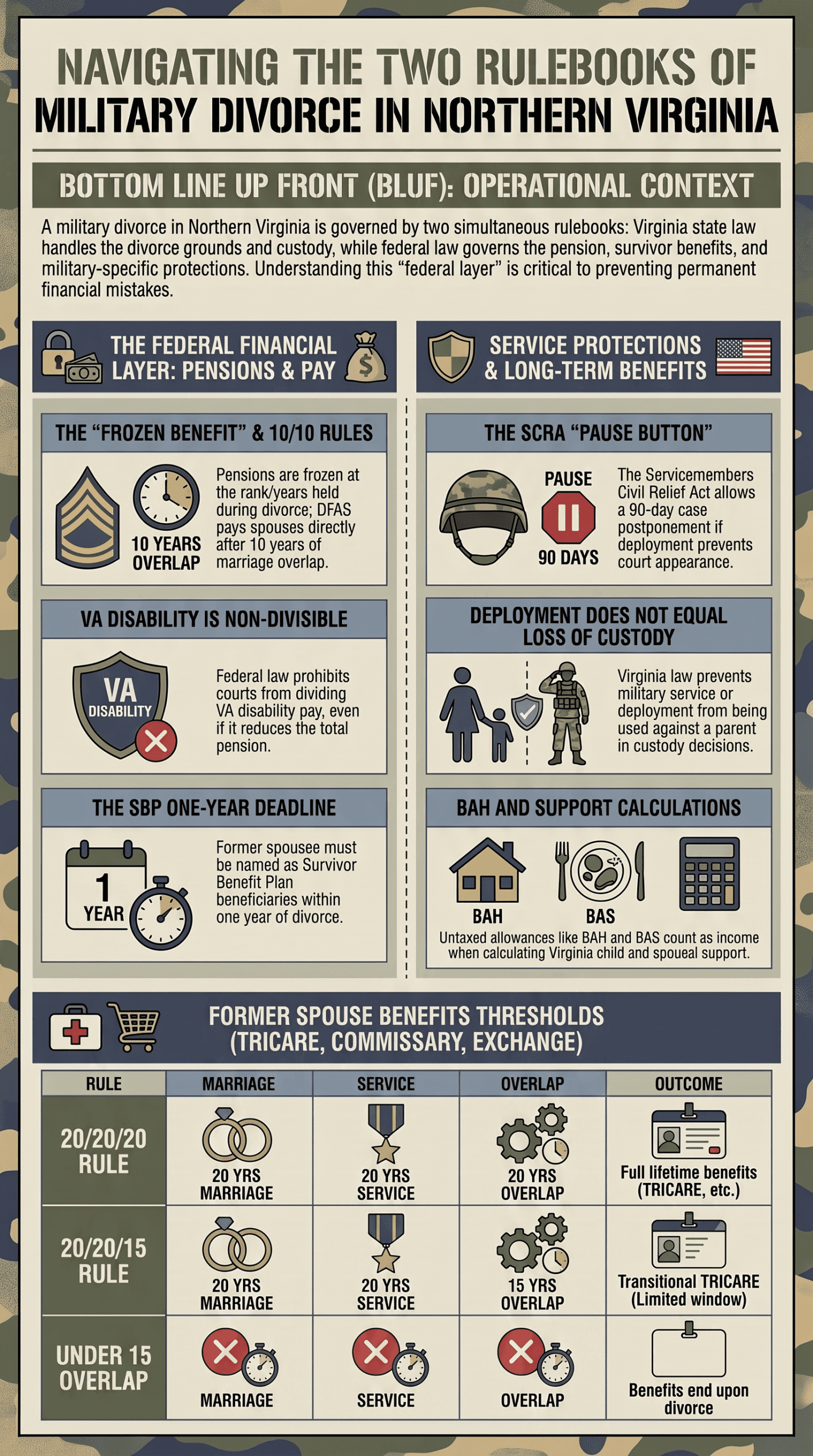
If you or your spouse serves, your divorce still runs through Virginia law, but a second layer of federal military rules sits on top of it, and that layer is where most of the worry lives. Where you can file turns on residency and domicile, not just where you are stationed. A military pension is divided under a federal law called the USFSPA, and how much a former spouse receives depends on rules with plain names like the 10/10 rule and the frozen benefit rule. VA disability pay cannot be divided, no matter what an agreement says. Benefits like TRICARE survive a divorce only when the marriage meets the 20/20/20 test, and custody has to plan around deployment in a way civilian cases never do.
None of this is as frightening as it sounds once someone walks you through it, and that is what this guide is for. The single most useful thing you can do is talk to a family law attorney who handles military cases before you sign anything or make a major decision. The first call is a conversation, not a commitment.
What This Guide Covers
- What Makes a Military Divorce Different
- Where You Can File: Residency and Domicile
- The SCRA and the Pause Button on Your Case
- Serving Papers When One of You Is Deployed
- Dividing the Military Pension Under the USFSPA
- DFAS Direct Pay and the 10/10 Rule
- VA Disability and Why Courts Cannot Divide It
- The Survivor Benefit Plan
- The Thrift Savings Plan and Other Assets
- Former Spouse Benefits: The 20/20/20 Rule
- BAH, BAS, and How Military Pay Shapes Support
- Custody and Visitation When a Parent Serves
- Child Support in a Military Family
- Spousal Support and the Career Set Aside
- The Bases, Commands, and Stressors We Know
- County by County: Fairfax, Prince William, Stafford, Arlington
Chapter 1: What Makes a Military Divorce Different
The Short Answer
A military divorce is still a Virginia divorce, but a layer of federal military rules sits on top of state law, and that layer decides things state law cannot, like how a pension is divided and which benefits a former spouse keeps.
When you or your spouse wears the uniform, your case runs through two rulebooks at the same time. Virginia law governs the divorce itself: the grounds, the property, custody, and support. Federal law governs the military pieces: the pension, the Survivor Benefit Plan, base benefits, and the protections a deployed servicemember gets in court.
I tell every military family the same thing on the first call. The state parts are familiar, the same parts any divorcing couple in Virginia works through. It is the federal parts that cause the worry, and once you understand them, the fear settles into a list of decisions you can actually make. If you want the civilian foundation first, start with our guide on how to get a divorce in Virginia, then come back here for the military layer. You can also see our military divorce overview for a quick summary of how we help.
Chapter 2: Where You Can File, Residency and Domicile
The Short Answer
You can file for divorce in Virginia if you or your spouse has lived here and intended to make it home for at least six months before filing, and being stationed here can count.
Military families move a lot, so the first question is always where you are allowed to file. Virginia asks for six months of residency and domicile before the suit begins. Domicile means the place you treat as your true home: the state on your driver’s license, your voter registration, where your vehicles are registered. (Va. Code § 20-97)
A servicemember stationed in Virginia, or a spouse living here on those orders, can usually meet this even when the legal home of record is another state. Where you file matters because it sets which state’s law divides your property and sets support, and those rules differ from state to state. When both spouses have ties to different states, we look closely at which forum protects you best before anyone files a thing. For how a Virginia divorce unfolds step by step, see our divorce practice page.
Chapter 3: The SCRA and the Pause Button on Your Case
The Servicemembers Civil Relief Act, a federal law most people just call the SCRA, exists so that no one loses a divorce, a custody decision, or a support order simply because they were deployed and could not be in the room. If active duty materially affects a servicemember’s ability to take part, the court can postpone the case for at least ninety days, and a default judgment cannot be entered against a protected servicemember who is absent. (50 U.S.C. § 3901 et seq.)
A Shield, Not a Sword
The SCRA does not let a servicemember stall a case forever, and a judge can require proof that duty truly prevents appearing. But it does make sure that serving your country never costs you your day in court. If you are the civilian spouse, this is the main reason a military case can move more slowly than you expected, and that slower pace is built in on purpose.
Chapter 4: Serving Papers When One of You Is Deployed
Serving divorce papers gets harder when one spouse is in the middle of a deployment or has just relocated on a permanent change of station, which the military calls a PCS move. We work with the realities of military life: an APO or FPO mailing address, a spouse on the other side of the world, a household suddenly split across two duty stations.
The goal is clean service that holds up if anyone challenges it down the road, paired with the SCRA protections from the last chapter so nothing is decided while a servicemember genuinely cannot respond. Doing this correctly at the very start saves months of untangling it later, and it keeps the case on honest footing for both sides.
Chapter 5: Dividing the Military Pension Under the USFSPA
The Short Answer
A military pension earned during the marriage can be divided in a Virginia divorce under a federal law called the USFSPA, and since a 2017 change, the marital share is generally frozen at the rank and years of service as of the date of divorce.
The pension is often the largest asset a military family owns, and dividing it frightens people on both sides of the table. Let me make it plain. The USFSPA, which stands for the Uniformed Services Former Spouses’ Protection Act, lets a state court treat the part of the pension earned during the marriage as marital property. Virginia then divides that marital share fairly under its equitable distribution rules. (10 U.S.C. § 1408)
The frozen benefit rule, which came out of the 2017 defense bill, means a former spouse’s share is calculated using the servicemember’s rank and service time at the date of divorce, not at some future retirement years later. There is also the 10/10 rule, which I cover next, that decides how the money actually gets paid.
Here is the part that matters most: none of this happens automatically. The pension has to be addressed in the order, with the correct military language, or a former spouse can lose the share entirely. This is the document I never let a military family sign without a careful second look. For the civilian side of retirement, see our page on dividing retirement accounts.
Chapter 6: DFAS Direct Pay and the 10/10 Rule
The Short Answer
If the marriage and the military service overlapped by at least ten years, the Defense Finance and Accounting Service (DFAS) can pay the former spouse’s share of the pension directly, instead of relying on the retiree to send it.
This is the 10/10 rule, and people get it backward all the time, so let me be clear about what it does and does not do. The 10/10 rule does not decide whether a former spouse receives a share of the pension. It only decides how that share gets paid.
With ten years of marriage that overlapped ten years of service, DFAS sends the share straight to the former spouse, like a paycheck, so no one has to chase a monthly check. Below that overlap, a former spouse can still be awarded a share, but the retiree has to pay it over directly, which we plan around with safeguards written into the agreement. Disposable retired pay, which is the amount DFAS is allowed to divide, is the pension after certain deductions are taken out, and what counts toward that number leads straight into the disability question in the next chapter.
Chapter 7: VA Disability and Why Courts Cannot Divide It
The Short Answer
VA disability pay cannot be divided in a divorce, no matter what a decree says, because federal law and the Supreme Court put it off limits.
This is the one that breaks hearts, so I will give it to you straight. When a retiree waives part of a taxable pension in order to receive tax-free VA disability pay, that disability money is not marital property, and a court cannot divide it.
The Supreme Court said so in Mansell v. Mansell back in 1989. Then, in Howell v. Howell in 2017, the Court went a step further and held that a state court cannot order a veteran to make up the difference to a former spouse when a later disability waiver shrinks the divided pension.
What This Means Years Later
A pension share can shrink years after the divorce if a retiree’s disability rating changes, and there may be no way to claw it back. I have seen it happen to good people who never saw it coming. The honest fix is to anticipate it inside the agreement, with language that protects a former spouse if a future waiver reduces the share.
Chapter 8: The Survivor Benefit Plan, Insurance for a Pension
Here is why the Survivor Benefit Plan, or SBP, matters so much. A divided pension pays only while the retiree is alive. If the retiree dies first and there is no SBP coverage naming the former spouse, that income simply ends, often for the very person who counted on it most. The SBP continues a portion of the pension to the named survivor for the rest of their life. (10 U.S.C. §§ 1447 to 1455)
A Deadline You Cannot Reopen
A former spouse can be named as the SBP beneficiary, but the election usually has to be made within one year of the divorce and spelled out clearly in the order. I treat the SBP as a required conversation in any case with a pension, because the deadline to lock it in cannot be reopened once it passes. Missing it is one of the few mistakes in this whole area that truly cannot be fixed.
Chapter 9: The Thrift Savings Plan and the Rest of Your Assets
Beyond the pension, military families build the same kinds of assets as anyone else: a Thrift Savings Plan, which is the military’s version of a 401k, savings accounts, vehicles, and sometimes a home bought near one duty station and rented out after the next set of orders. Virginia divides marital property fairly, weighing things like each spouse’s contributions and the length of the marriage.
The Thrift Savings Plan is split using its own type of court order. We map every account, separate what is marital from what each spouse brought in or kept apart, and divide it cleanly so nothing is missed. Our pages on property division and retirement accounts go deeper on the civilian side of all this.
Chapter 10: Former Spouse Benefits, the 20/20/20 Rule
The Short Answer
A former spouse keeps full military benefits, TRICARE health coverage, commissary, and exchange, only if the marriage meets the 20/20/20 rule: 20 years of marriage, 20 years of creditable service, and 20 years of overlap between the two.
This is the rule people search for more than any other, so let me lay it out cleanly.
- The 20/20/20 rule. With all three twenties met, the former spouse keeps TRICARE and base privileges for life, as long as they do not remarry.
- The 20/20/15 rule. Where the overlap is at least fifteen years instead of twenty, the former spouse gets a limited window of transitional TRICARE, not the full package.
- Below those marks. Military health coverage ends with the divorce, though the former spouse may be able to buy temporary coverage through a program called CHCBP, the Continued Health Care Benefit Program.
Whether you hit these numbers shapes the entire negotiation, because losing TRICARE is a real and measurable cost, and it belongs on the table when you talk about support and property. Speaking of support, military pay is where the next chapter goes.
“A military divorce is not two divorces. It is one divorce with a second rulebook, and the families who get hurt are the ones who did not know the second book existed.”
Alisa Chunephisal, Esq. · Founding Partner
Worried about your pension, your benefits, or your kids?
That is exactly what a first call is for. Tell us what is going on, and we will walk you through the Virginia side and the military side together. No pressure, no judgment.
Chapter 11: BAH, BAS, and How Military Pay Shapes Support
The Short Answer
Military pay, including Basic Allowance for Housing (BAH) and Basic Allowance for Subsistence (BAS), counts as income for Virginia child and spousal support, and divorce can change which BAH rate a servicemember draws.
This is where the questions I hear most often live, so let me answer them straight on.
Do you still get BAH after divorce if you have no dependents?
Generally, a single servicemember with no dependents draws BAH at the without dependents rate, if entitled to it by rank, location, and orders. The rate follows your situation, not the divorce itself.
Do you still get BAH after divorce if you have dependents?
If you still support a child who qualifies as a dependent, you may continue drawing BAH at the with dependents rate. The rate follows your actual dependents, so a child you support can keep you at that rate even after the marriage ends.
When does BAH stop after divorce?
Divorce by itself does not switch BAH off. What changes is that a former spouse no longer counts as a dependent, which can move you from the with dependents rate to the without dependents rate. Living in government quarters changes the picture too.
Confirm the Numbers
Pay rules are set by the Department of Defense and they do change, so confirm your exact entitlement with your finance office or a JAG attorney. For support, the point to hold onto is that allowances count as income even though they are not taxed, which catches both spouses by surprise more often than not.
From there, the calculation runs through Virginia’s child support and spousal support rules.
Chapter 12: Custody and Visitation When a Parent Serves
The Short Answer
Virginia decides custody by the best interests of the child, your service cannot be held against you just because you serve, and the law lets a deploying parent get a temporary arrangement that reverts when you return home.
Custody is the part of a military divorce that frightens parents most, and I understand exactly why. Orders, deployments, and the next move make a tidy civilian schedule feel impossible. The good news is that Virginia law protects deploying parents in real, concrete ways. (Va. Code § 20-124.3)
- A court cannot treat your military service or a past deployment as a strike against you in deciding custody.
- A deployment can be handled with a temporary arrangement that ends when you come home, rather than a permanent change that outlives the deployment.
- In many cases you can ask to pass your parenting time to a family member, like a grandparent, while you are away, so your child keeps that connection to your side of the family.
A family care plan, which the military already requires you to keep, works right alongside the custody order. We build schedules designed to survive a deployment instead of breaking on contact with one. Our guide to the best interests of the child explains the factors a judge weighs, our child custody page covers the full picture, including how joint custody works, and if a situation turns urgent, see emergency custody. If the other parent is not following the order, here is how to enforce a custody or visitation order.
Chapter 13: Child Support in a Military Family
Two things run side by side here. First, Virginia’s child support guideline uses both parents’ gross income, which includes military pay and allowances, along with the parenting schedule, to set the number. Allowances like BAH count even though they are not taxed, as we covered above. (Va. Code § 20-108.2)
Second, every branch of service has its own interim support rule that obligates a member to support dependents until a court order or written agreement sets the amount. A commander can get involved if a member ignores that duty, which gives the family at home a real avenue for help. If your income or schedule changes after an order is in place, our page on support modification explains how and when to adjust it, and the Division of Child Support Enforcement, which Virginia calls DCSE, handles enforcement when payments stop.
Chapter 14: Spousal Support and the Career That Was Set Aside
Let me say something I believe deeply. The spouse who did not serve often paid a price that never shows up on a pay stub: jobs left behind at every move, a degree paused, a career that never got to begin because the family kept relocating for the mission. Virginia weighs that contribution. (Va. Code § 20-107.1)
When a court looks at spousal support, it considers the length of the marriage, what each spouse contributed, and the life the two of you built together, including the work of the spouse who held the home steady through every deployment and every absence. Support is not automatic, and it is not a punishment. But that sacrifice is part of the picture, and I make sure the court actually sees it, because it is real and it counts.
Chapter 15: The Bases, Commands, and Stressors We Know
We serve military families from every corner of the Northern Virginia defense community, and the geography matters, because where you are stationed often shapes the pressures you carry into a divorce.
The commands and agencies around you
Across our counties you will find the Pentagon and the National Guard Bureau in Arlington, with Joint Base Myer-Henderson Hall right beside them. Fort Belvoir sits in Fairfax County, home to the Defense Logistics Agency, the Defense Threat Reduction Agency, and the Army’s Intelligence and Security Command. The National Geospatial-Intelligence Agency is in Springfield, and the National Reconnaissance Office is out near Chantilly. To the south, Marine Corps Base Quantico straddles Prince William and Stafford counties, home to Officer Candidates School, The Basic School, Marine Corps University, and the Naval Criminal Investigative Service. We work with active duty, Guard and Reserve, civilians, and the contractors tied to all of them.
The stressors that come with the uniform
Service brings pressures a civilian divorce rarely carries, and naming them out loud helps. Deployment and long separation strain even strong marriages. A high operational tempo means missed birthdays and missed holidays that add up over the years. Frequent moves uproot children and stall the other spouse’s career again and again. Many servicemembers carry a real and reasonable worry that a divorce, or the money side of it, could affect a security clearance. Some are living with post traumatic stress, a traumatic brain injury, or the quiet weight of combat. Dual military couples face a logistics puzzle stacked on top of the heartbreak. And the spouse at home has often carried the household alone, through every absence, while setting aside a life of their own.
I do not treat any of this as background noise. It is the heart of why these cases need someone who actually understands military life, not just family law. You are not a file number to us, and your service is not a footnote.
Chapter 16: County by County, Fairfax, Prince William, Stafford, Arlington
The Short Answer
You file your military divorce in the Circuit Court of the Virginia county where you meet residency, and we handle all four of our home counties, each with its own court and its own rhythm.
Fairfax County
Home to Fort Belvoir and a deep defense and intelligence community. Divorces are filed in the Fairfax County Circuit Court, while custody and support matters often start in the Juvenile and Domestic Relations District Court. See our guide to child custody in Fairfax County.
Prince William County
Shares Marine Corps Base Quantico and carries a strong Marine and Army presence. Cases run through the Prince William County Circuit Court and its Juvenile and Domestic Relations District Court. See our guides to divorce in Prince William County and child custody in Prince William County.
Stafford County
The southern side of Quantico, home to many Marine families. Divorces are filed in the Stafford County Circuit Court, with custody and support matters in its Juvenile and Domestic Relations District Court.
Arlington County
The Pentagon, the National Guard Bureau, and Joint Base Myer-Henderson Hall. Cases are heard in the Arlington County Circuit Court and its Juvenile and Domestic Relations District Court.
Wherever you file, the law is the same Virginia law. But local courts move at their own pace and have their own habits, and knowing each one helps us set your expectations honestly from day one.
Alisa’s Honest Counsel
The single most expensive mistake in a military divorce is signing an agreement that ignores the federal pieces. A pension share with no Survivor Benefit Plan, or a decree that forgets the disability rule, can quietly cost a family hundreds of thousands of dollars years after the ink is dry. Get the military language right the first time, because some of these deadlines and elections simply cannot be reopened once they pass.
Authoritative References
Sources and further reading
A military divorce is governed by federal law and Virginia statute together. These are the primary, authoritative sources behind this guide, in APA style. Laws and pay rules change, so always confirm the current version with an attorney before you act.
- Uniformed Services Former Spouses’ Protection Act, 10 U.S.C. § 1408 (1982). The federal law allowing state courts to divide military retired pay.
- Servicemembers Civil Relief Act, 50 U.S.C. § 3901 et seq. (2003). Protections that can pause civil cases during active duty.
- Survivor Benefit Plan, 10 U.S.C. §§ 1447 to 1455 (1972). The program that continues a pension to a named survivor.
- Howell v. Howell, 581 U.S. 214 (2017). A state court cannot order a veteran to indemnify a former spouse for a disability waiver that reduces divided pension pay.
- Mansell v. Mansell, 490 U.S. 581 (1989). VA disability pay waived from retired pay is not divisible as marital property.
- National Defense Authorization Act for Fiscal Year 2017, Pub. L. No. 114-328 (2016). Created the frozen benefit rule for dividing military pensions, amending 10 U.S.C. § 1408.
- Code of Virginia, Title 20 (Domestic Relations). Spousal support § 20-107.1, equitable distribution § 20-107.3, child support guideline § 20-108.2, best interests of the child § 20-124.3, and the effect of military service and deployment on custody (section to be confirmed against the current code). law.lis.virginia.gov/vacode/title20
- Defense Finance and Accounting Service (DFAS). Former spouse pension division and garnishment guidance. dfas.mil
- TRICARE. Former spouse eligibility, including the 20/20/20 and 20/20/15 rules. tricare.mil
- U.S. Department of Defense. Basic Allowance for Housing (BAH) policy and current rates. defensetravel.dod.mil
Verified as of June 2026. This guide is general information, not legal advice for your specific situation. Federal pay rules and benefit programs change often, and the 2026 Virginia General Assembly session touched several family law statutes, so every citation above must be confirmed against current law before it is relied on. For advice on your case, speak with a Virginia family law attorney, and for pay and benefit specifics, your finance office or a JAG attorney.
Frequently Asked Questions
What makes a military divorce different in Virginia?
A military divorce runs through two rulebooks at once. Virginia law governs the divorce, the property, custody, and support, while federal military law governs the pension, the Survivor Benefit Plan, base benefits, and the protections a deployed servicemember gets in court. The state parts feel familiar. It is the federal layer that needs an attorney who handles military cases.
Where can I file for divorce if I am stationed in Virginia?
You can file in Virginia if you or your spouse has lived here and treated it as home for at least six months before filing. Being stationed in Virginia can satisfy this even if your legal home of record is another state. Where you file decides which state’s law divides your property and sets support, so it is worth getting right.
How is a military pension divided in a Virginia divorce?
The part of the pension earned during the marriage can be divided under a federal law called the USFSPA, and Virginia then splits that marital share fairly. Since a 2017 change, the share is generally frozen at the servicemember’s rank and service time as of the date of divorce. The pension must be addressed with the correct military language in the order, or a former spouse can lose the share.
What is the 10/10 rule?
If the marriage and the military service overlapped by at least ten years, the Defense Finance and Accounting Service can pay a former spouse’s pension share directly. The 10/10 rule only decides how the share is paid, not whether a former spouse receives one. Below that overlap, the retiree pays the share over directly.
Can VA disability pay be divided in a divorce?
No. VA disability pay is not marital property and a court cannot divide it. The Supreme Court confirmed this in Mansell v. Mansell and Howell v. Howell, and a court also cannot order a veteran to make up the difference when a disability waiver shrinks a divided pension. This risk should be planned for inside the agreement.
What is the 20/20/20 rule in the military?
It is the test for full former spouse benefits. With 20 years of marriage, 20 years of service, and 20 years of overlap, a former spouse keeps TRICARE, commissary, and exchange privileges for life unless they remarry. The 20/20/15 rule, with 15 years of overlap, gives a limited period of transitional TRICARE instead.
Do you still get BAH after divorce?
Divorce does not switch BAH off. A servicemember with no dependents generally draws the without dependents rate, while a member who still supports a child may keep the with dependents rate. A former spouse simply stops counting as a dependent, which can change the rate. Pay rules change, so confirm your exact entitlement with your finance office or a JAG attorney.
Does military pay count as income for child support in Virginia?
Yes. Virginia’s child support guideline uses both parents’ gross income, and that includes military pay and allowances like BAH and BAS, even though allowances are not taxed. Each branch also has its own rule requiring members to support their children until a court order or agreement sets the amount.
How does deployment affect custody in Virginia?
Virginia cannot hold your military service against you, and the law lets a deploying parent set a temporary arrangement that ends when you return rather than a permanent change. You can often ask to pass your parenting time to a family member while you are away. Schedules can be built to survive a deployment.
What is the Survivor Benefit Plan and why does it matter?
A divided pension stops when the retiree dies unless the Survivor Benefit Plan continues a portion to a named survivor for life. A former spouse can be named, but the election usually has to be made within one year and written into the order. Miss the deadline and it generally cannot be reopened, so it should be treated as a required step.
The Takeaway
You served. Your divorce should respect that.
If you take one thing from this guide, take this: a military divorce in Northern Virginia is manageable, even the federal parts that feel overwhelming right now. Virginia law handles the divorce, the property, the children, and the support. Federal law handles the pension, the survivor benefit, the base privileges, and your protections while you serve.
The danger is almost never the rules themselves. It is not knowing they are there. Get them right, and you protect everything you and your family earned through every move and every deployment. You served, or you stood behind someone who did, and you deserve a divorce that honors that. When you are ready, we are here.
When You Are Ready
Let’s protect what you earned. Let’s talk it through.
I wrote this guide so you would walk in informed. The next step is a real conversation about your situation, the Virginia side and the military side together. Three offices across Northern Virginia, one phone number. The first call is a conversation, not a commitment.